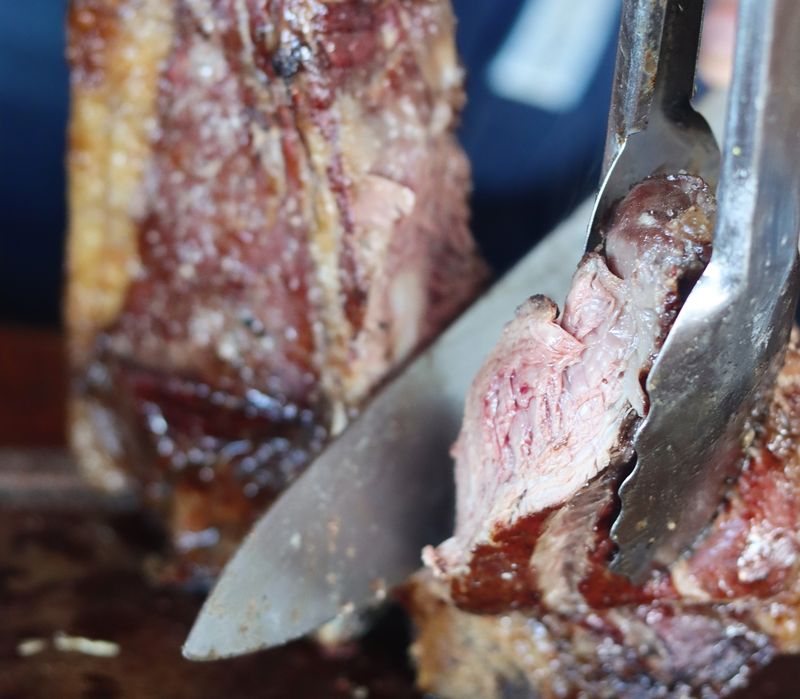
What is Argentine asado?
Asado is a cooking technique in which meat is exposed to the heat of the fire or the embers so it cooks slowly. In Argentina it’s also a social custom. The Ministry of Tourism puts it this way: “It goes with get-togethers, with Sundays spent with family or friends. It’s more than food; it’s a whole ritual.”
The grill master, or asador, is in charge of the asado: the only person who touches the meat and tends the fire. And there’s a table rule kept all over the country: at the end, a round of applause for the asador. In English, people look it up as “Argentine asado,” “Argentine barbecue” or “Argentinian barbecue.”
Where it comes from
The first cattle reached the region in 1556, according to the Argentine Beef Promotion Institute (IPCVA). By the 18th century the pampas held some 40 million head of cattle, and gauchos rode out on “vaquerías” to hunt the feral herds. By the early 20th century asado was already a tradition in the countryside, though the Buenos Aires elite preferred French cooking.
The fire: wood, embers and patience
Asado is cooked over embers, not over a freshly lit flame. First you light the fire with hardwood or charcoal; once there are embers, you spread them evenly under the grill, let the iron heat up, and only then does the meat go on. A well-made asado takes several hours of fire and work.
A few details the tradition keeps repeating:
- The wood: hardwoods such as quebracho or coronilla burn hot and for a long time.
- The first side: the cook Petrona C. de Gandulfo wrote that, once the embers are ready, the meat goes on “fat side down” and stays there until the lower half is cooked; only then is it turned.
- When to turn it: the asador’s experience decides, just as it decides the height of the grill and the amount of embers.
- The wind: in Patagonia east of the Andes, people use the chulengo, a 200-liter drum cut in half, to shield the fire and the meat from strong winds.
That’s what you practice in the workshop: how to light the fire, when the embers are ready, how to lay out the cuts and how long to wait without touching them.
Classic cuts of Argentine asado
The most common cuts are asado de tira and vacío, according to the Ministry of Tourism. Chorizo and morcilla usually come before the meat, and many asados also include achuras such as sweetbreads, chinchulines and kidneys. The list below is general background; it isn’t the Asado Workshop’s list of cuts.
| Cut or item | What it is |
|---|---|
| Asado de tira | Ribs cut into strips about 5 to 8 cm wide |
| Vacío | Flank, from the belly; it goes on the grill in one piece |
| Matambre | A classic beef cut for asado |
| Entraña and colita de cuadril | Skirt steak and tri-tip, cuts that also show up at many asados |
| Chorizo and morcilla | Sausage and blood sausage that open the asado; in a bread roll they’re choripán and morcipán |
| Achuras | Sweetbreads, chinchulines (small intestine), kidneys and other offal |
Chimichurri
Chimichurri is an almost liquid, heavily seasoned sauce. Its core ingredients are parsley, oregano, garlic, vinegar, oil, crushed red pepper and a little salt; some versions add onion. It goes with grilled meat and choripán, and it also works as a marinade.
Its origin is unclear: there’s an Andean theory, a Basque one and a legend about British soldiers, none of them firmly documented. At the Asado Workshop you make chimichurri.
Asado and lamb in Patagonia
In the south, asado has another star: lamb. Cordero a la estaca, or a la cruz, is a Patagonian tradition: a whole lamb fastened to an iron frame driven into the ground next to the fire. The technique, the season and why Patagonian lamb is different are covered in the Patagonian lamb guide.
Why learn it at a Patagonian estancia
At an estancia the fire is built out in the open country, and the Patagonian wind is part of the job. The Asado Workshop takes place at Estancia Rio Mitre, 58 km (36 miles) from El Calafate, facing the Andes and overlooking Lake Rico. The host is Matías “Chacho” Chaumeil, grill master and owner of Medio Perro, with more than 23 years of experience. The day also includes free time to roam the open country and the Centro de Interpretación Tehuelche (Tehuelche Interpretation Center), with original Tehuelche arrowheads, boleadoras and tools from the region.
Asado Workshop by Medio Perro at a glance
| What it is | A class to learn how to cook Argentine asado |
|---|---|
| Where | Estancia Rio Mitre, 58 km from El Calafate and 30 km from the Perito Moreno Glacier |
| Who runs it | Medio Perro; host Matías “Chacho” Chaumeil |
| When | Daily from August to May |
| Schedule | Pickup at 11:30 am in El Calafate; estimated return 4:30–5:00 pm |
| Price | USD 180 per person |
| Includes | Round-trip transfers, workshop, chimichurri, wine tasting (with non-alcoholic drinks), free time to roam the open country and the Centro de Interpretación Tehuelche |
| Not included | Glacier visit; optional 1-hour horseback ride |
Is an asado class worth it?
It’s worth it if you want to go home knowing how to build the fire, read the embers and give the meat the time it needs. If you just want to eat Patagonian lamb, a table in town will do: Medio Perro BBQ & HOME, at Puerto Deseado 153, serves braised Patagonian lamb every day from 1:00 pm to 11:00 pm.
How to book
The price and the workshop FAQ are on the home page. Check availability on WhatsApp from the booking section; bookings are confirmed with full payment by bank transfer. To get to know the place before you decide: Estancia Rio Mitre: where it is and how to get there.